Copyright The Boston Globe
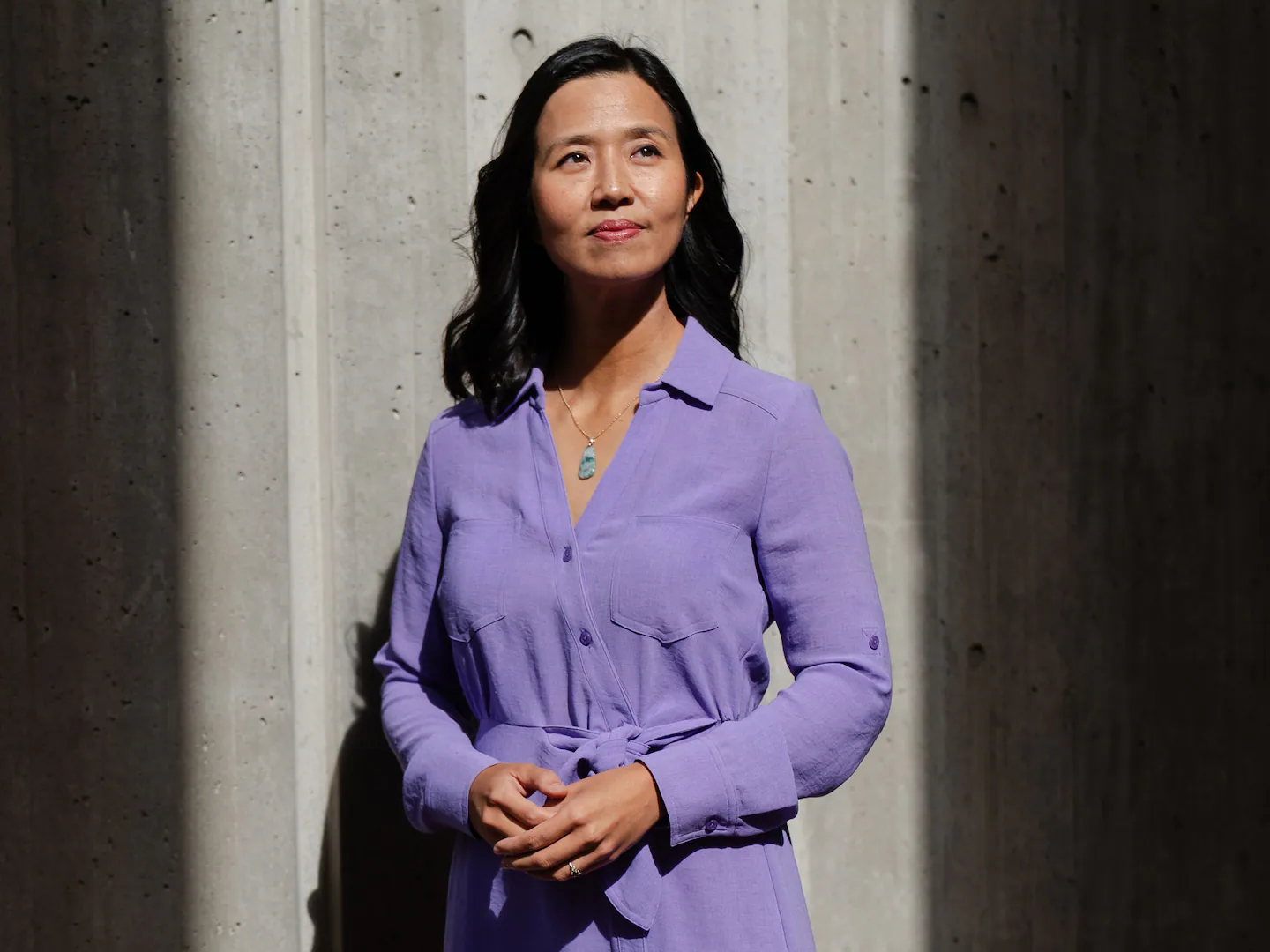
It had been three weeks since Wu clinched a decisive victory in the city’s preliminary election for mayor, winning 72 percent of the vote and chasing opponent Josh Kraft from the race. Since then, previously scheduled fund-raisers such as this have taken on the tone of pep rallies. If her first election as mayor gave her a strong mandate, now Wu has a margin of support that would satisfy a third-world dictator, as one former city pol put it to me. Four years ago, city cops loathed her; this year, the largest Boston police union endorsed her. Her allies stock the City Council and Democratic ward committee leadership ranks, and nationally known Democrats, including the likely next mayor of New York City, point to her as a model. “My God, is she on top of her game,” says Carol Lasky, co-chair of the Ward 4 Democratic Committee. “Has she grown? Has she found an amplified version of her voice?” It “has always been very strong,” Lasky adds, “but not like this.” In that room on the 25th floor of the Prudential Tower, the mayor is on top of the city. Wu, 40, is slim and soft-spoken, with an unyielding poise and movements that feel deliberate. When she hands off her infant daughter, Mira, to take the microphone, everyone offers a willing pair of arms. When she speaks, every joke lands. Even if she hasn’t always courted the spotlight, here she is, enjoying the afterglow. If this newest version of Michelle Wu has an origin story, it is this. On January 13, the mayor gave birth to her third child, Mira. On January 27, she received a request — not quite an invitation, not quite a subpoena — to appear before the Republican-led US House Oversight Committee, to answer for Boston’s so-called sanctuary city policies. In early March, seven weeks postpartum, Wu appeared in a royal blue dress beside three male mayors in droll dark suits. Political strategists could hardly have dreamt up a more salient image. She had the Ash Wednesday cross on her forehead and a baby in her arms, a pink cloth draped over her shoulder to nurse in the final few minutes before the cameras and the hot lights rumbled on. (The next day, at a routine appointment with her obstetrician, an intake form would ask: In the last seven days, have you experienced any anxiety?) The standard advice on what to do when you appear before Congress is to shut up and duck. The hearings are made-for-TV moments, and as the witness you’re unlikely to enjoy your starring role. Think of the university presidents whose careers ended after viral flubs before our nation’s leaders. To prepare for the onslaught, Wu hired a D.C. law firm at the rate of $950 per hour, holding a dozen prep sessions. (The bill would ultimately total more than $750,000.) She consulted Kristen Orthman, a political strategist who had worked for the Biden White House and Elizabeth Warren’s presidential campaign. Wu called each member of Massachusetts’ congressional delegation, some of whom serve on the oversight panel. When the interrogation began, Wu seemed not to be ducking. As Republicans on the committee tossed out bait, she batted it back. She rejected their premises and corrected their claims. And she challenged the committee, too — the crime rate in Boston is lower “than your district,” she told a Republican congressman in one pointed exchange. It was immediately one of those moments. Here was a woman leader who had managed to make child rearing a political advantage. Here was a potent foil to President Trump: a young woman and mother, calm and well spoken, a Harvard graduate two times over, the daughter of Taiwanese immigrants who was a citizen thanks to the birthright citizenship clause Trump has attacked. Here was a progressive leader whose housing-dense, diverse, innovative city could not be caricatured as a crime-ridden hellhole in need of federal takeover — a city where, as Wu repeated over and over, violent crime is near the lowest in the nation. While the hearing was still going on, Wu’s team blasted out fund-raising emails and social media posts featuring her best moments. When the Globe published an early version of the story, three Wu allies texted me almost simultaneously to complain that our headline did not go far enough to capture her triumph. “‘Emerged largely unscathed’?” they gaped. One added a thumbs down emoji. In the months since, Wu’s performance at the congressional hearing has become shorthand for a kind of political savviness no one can dispute. The mayor recounts it at fund-raisers. Voters mention it unprompted. Nearly every person I interviewed for this story brought it up. If Wu’s reelection year has been a championship run, the hearing was the first scene in her highlight reel. Cue music. “Shame on him for lying about my city,” she said of Trump’s border czar, in the first few moments of the hearing. Cut to: Mayoral forum in May. Candidates are asked what city ward they live in, and Wu’s chief opponent, Kraft, sheepishly confesses he does not know. Wu leans forward and silently holds up three fingers. Open on: the night of the preliminary election, Adams Park, Roslindale. Another blue dress, another adoring crowd. “Today,” she told supporters, “you sent a message to Josh Kraft, to Donald Trump, and to all their enablers: Boston is not for sale.” Just watch the montage: Wu is better at this than she used to be. She also seems to take pleasure in driving up the score. “Forty-nine points,” Wu joked to the cheering women at the fund-raiser, referring to her staggering margin of victory over Kraft. “You know, I did want that last percentage point, but it’s fine, close enough.” On the last truly summer Saturday afternoon of the year, in Boston’s most suburban southwest corner, parents gathered for the time honored tradition of children’s soccer in Millennium Park. One of them was Wu, in an Eastie T-shirt and an Institute of Contemporary Art hat, toting a folding chair and a collection of teething-friendly snacks for the baby. As she settled in to watch her eldest, Blaise, many people recognized her, but not everyone. When she kicked an errant ball back into play, some of the kids didn’t notice or care that it came from the mayor. Other children were incredulous to see her there in the grass, as if she might be an imposter. “Wait, is that you, Michelle Wu?” asked one little boy in a blue soccer jersey. She laughed, nodded. “Who are you?” One boy, around 10 but taller than the rest of his team, had a more serious agenda. “I just wanted to ask about your campaigning strategies.” He introduced himself as Carter. “Are you planning to, like — um — are you planning to become mayor again?” “Yes,” she said, explaining that the first round of voting is over, and the final round — now just a formality for her — is on November 4. “What are your thoughts about the opposing party?” he asked. “Josh Kraft.” “So, Josh Kraft dropped out, actually,” Wu had the pleasure of explaining. “When the votes were counted up in September, we got 72 percent of the votes and he got 23 percent of the votes.” “Wow,” Carter remarked. “Have you even met him?” he wanted to know. “Do you think he’s a nice guy?” “I don’t know,” Wu said, and shrugged. “I didn’t get to spend enough time to really know.” She quickly put on her Mayor Face. She was midway through “anyone that runs for office is really brave” and “I’m very grateful” when another player interrupted to ask for a team photo. They smiled, someone snapped, and soon the blue team was back to its drills. Carter was getting at a point that the city’s political elite have been making for weeks. What Wu has done is unprecedented — win so convincingly that her opponent dropped out before the second round. You must be feeling on top of the city right now, I offered, as Mira waddled and wiggled across a purple-and-white striped blanket. The baby — so charming as to undermine one’s journalistic professionalism — reached for my pen, and I tried to ply her with a rattle instead. “It’s definitely rewarding, and a bit of a relief,” Wu said. But she pointed to the work ahead, and declined to take the victory lap. “I have the gift and blessing of getting to steward the most incredible place on the planet,” she said. And with 22 percent turnout, the election was not necessarily a full-throated endorsement. “I don’t take it as the vast, vast majority of the city is 100 percent happy with everything that’s going on,” she said. “I heard a lot on the campaign trail about things we need to do better.” She was studiously avoiding making the conversation about herself. “We’re in an existential moment that’s really about who belongs and who counts, and cities have a very real, beautiful answer to that question that Donald Trump doesn’t want to hear,” she said. “This is an amazing community where people know how to get things done and how to take care of each other ... and that would be true no matter who is mayor, and certainly no matter who is president.” But it is at least in part about her, this moment. When Trump’s border czar attacked Boston last fall, he made it about immigration policy, but also about Wu herself. (“Well, she’s not very smart, I’ll give her that,” Tom Homan said.) And the 66,859 people who backed Wu in September were voting for a person, not for Boston as an idea or for some city on some hill. Half of voters don’t like bike lanes, but two-thirds like Michelle Wu, who is building bike lanes, polling tells us. Fifty-seven percent of voters think Boston Public Schools are worse than “good,” but 66 percent approve of Michelle Wu, who is in charge of Boston Public Schools. Half of voters say living in Boston is unaffordable, but well over half like Michelle Wu, who has yet to make the city affordable. In the dozens of interviews I did with Boston voters this year, some mentioned Wu’s climate agenda, the seats she has added to child-care facilities, the bus lines she has made fare-free. But more spoke about the person they perceive Wu to be. They like that she appeared at their Lunar New Year event and answered their questions on the radio. They watch her videos on Instagram and they think her baby is cute and they like that she is a working parent, like them. They like that she is breaking barriers; they trust that she is doing her best. They were not voting for an anonymous set of qualifications and policy planks. They were voting for the woman with the ashes on her forehead and the baby in her arms, sitting calmly in Washington and giving it right back. When Wu was a child, she told me, her grandfather came to visit her family in Chicago. From Taiwan, he had resettled in Hawaii, and when he arrived in the Midwest that fall he didn’t have a coat. Wu, the eldest of her four siblings, went with him and her mother to Burlington Coat Factory. She remembers it like a paradise — endless racks of merchandise to hide behind or dress up in. As she played, the adults picked a coat and paid for it. The fun ended when they tried to leave the store. The alarm blared, and suddenly two burly security guards were descending upon her uncomprehending grandfather. In one pocket of his brand-new coat was a pair of gloves no one had remembered. Now they were being pulled into a side room and accused of shoplifting. Wu, 5 or 6 years old, was the only one who spoke enough English to translate. Her grandfather wasn’t trying to steal and they weren’t criminals, she tried to explain, as she looked around and noticed for the first time that everyone else in the store was white. It felt like forever before they let them go. As they left the store, Wu recalled, one of the men shouted at their backs: “Don’t come back again!” She decided not to translate that for her family. She had kept it together in the store, but when they made it home, she shut herself away to cry. Then she heard a knock at her door. It was her grandfather, wearing the giant puffy coat. “He said, ‘Don’t focus on the gloves,’” she recalls. “‘Focus on the coat.’” That was her immigrant family’s attitude, she says. Keep moving forward. Nothing Wu does is an accident. She takes her own notes in meetings and color codes her calendar. Before she ran for mayor in 2021, she had built a bedrock of relationships across the city — helping immigrants apply for citizenship in Chinatown, helping Puerto Rican leaders build a monument in Villa Victoria, helping BPS parents stuff envelopes. When Wu was first elected to the council, hailed as its progressive future, she angered supporters by backing the more conservative Southie Councilor Bill Linehan for council president. He was not someone she always lined up with on policy, but he was her district councilor, and she was playing the game. Two years later, when Wu herself was elected council president, Linehan handed her the gavel. In summer 2022, Wu’s first year as mayor, the Boston Cyclists Union planned a protest on Charles Street. “Even though Mayor Michelle Wu promised us bold, transformational change,” group members wrote, “the City just announced that they don’t have any plans to complete the Downtown Bike Network this summer. This is unacceptable.” It was significant — the first real public stand against her from left-leaning voters who should have been squarely in her corner. Wu headed them off at the pass. “Should I bike to work tomorrow?” she posted on Twitter the night before the protest. When she rode to work for the first time as mayor, news cameras in tow, Wu and her bike became the story. The image reset the narrative and made it into the coverage of the protest, blunting the criticism. She was showing she could handle her left flank. “Michelle understands politics better than probably anyone I ever served with,” says Matt O’Malley, a former city councilor. “Michelle has always been, obviously, this incredibly smart, brilliant mind, and has almost this preternatural understanding of what’s going to resonate with people and with the body politic,” O’Malley says. “Now, she’s been put on this national stage. ... She has gravitas that has always been there, but maybe now she’s more comfortable expressing it.” The Trump administration has given Wu new flanks to defend, but also new opportunities to flex. Six months after the congressional hearing this year, US Attorney General Pam Bondi wrote to Wu to demand that Boston change its policies on working with federal immigration authorities. The Trump administration threatened to withhold federal funds or even file criminal charges against local leaders who refused. How should the city respond, City Hall leadership wondered? In a letter, perhaps a speech? As the deadline approached, Wu gathered dozens of community members on a video call. What did they think she should say? She was there to listen, she told them. The next morning, on City Hall Plaza, Wu threw a press conference that felt like a party. “Stop attacking our cities to hide your administration’s failures,” Wu told Bondi and the cameras. “Boston follows the law, and Boston will not back down.” She stood, smiling but firm at the head of a diverse crowd of hundreds, as a mariachi band played. That isn’t to say the mayor hasn’t had her fair share of losses and stumbles. The city’s election department was put into receivership this year after the secretary of state identified “unacceptable” lapses, including polling places that did not have enough ballots for the 2024 election. As the cost of living rises, housing construction is at its lowest level in a decade. Business leaders remain unhappy, especially real estate developers who argue Wu has made it too expensive to build by adding affordable housing and green requirements for new buildings. Real estate is “apoplectic,” says Eastern Bank chair Bob Rivers, a Wu donor who says he thought he was supporting a pragmatist, but now considers the mayor more of an ideologue. The market is challenging everywhere, he acknowledges, but policies “that she has held fast to unfortunately have caused housing production to have stopped.” “She’s certainly less of a consensus leader than I thought she was going to be,” Rivers says. “There’s no doubt she is an iron fist in a velvet glove.” (This appears to be a point of sensitivity. At the Women for Wu fund-raiser, one prominent communications executive pulled me aside to assure me, without prompting, that the divide between Wu and business leaders is being overblown.) Perhaps more significantly, the Massachusetts Legislature — which due to antiquated state law holds immense sway over what cities here can do — has dealt Wu loss after loss, most recently rejecting her proposal to temporarily shift more of Boston’s tax burden from residents to businesses. She is trying again this year, but so far her political talents haven’t proven persuasive. State lawmakers have not embraced many of the policy proposals that headlined her first run for mayor: rent control, free public transit. “I would have hoped that we would have made more progress expanding free T,” Wu told me in our interview, when I asked about disappointments from her first term. The barrier she faces to that, and so many other things, is the state. Wu has strong allies in the Massachusetts House, where she refers to the powerful budget chairman Aaron Michlewitz as a “big brother.” But she has had less success in the Senate, where many of her priorities have died. Nor has Wu won many public plaudits from the governor. Maura Healey waded into other local elections this year, but when it came to the Boston mayor’s race, she said she would leave it to the voters. Endorsements are inside baseball, yes, but the lack of one suggests a chill in a relationship Wu will need. Critics argue Wu could accomplish more for the city if she forged stronger relationships with business leaders and on Beacon Hill. Wu “gets pretty focused and determined on what she wants to accomplish and how she feels the need to get there. And sometimes that translates into a feeling ... that she doesn’t listen,” said Jim Rooney, president of the Greater Boston Chamber of Commerce. “I think she’s smarter than that. I think she does hear it, I think she does listen, and she makes her own judgment that, ‘This is not consistent with the direction I want to head in.’” On the field that Saturday, Blaise’s team won 6-2, about the same ratio of votes Wu got over Kraft in September. In youth soccer, there is often a mercy rule. If the blue team pulls too far ahead of the white team, at some point, the little boys are supposed to ease up so that everyone still has fun. There is no mercy rule in Boston politics, as Kraft learned this year. Polls showed Wu 30 points ahead, then 50 points ahead, yet she never stopped shooting on goal. She dismissed his rhetoric as “Kraft macaroni baloney.” She referred to the money he drew from his family business as “a billionaire’s son’s allowance.” He had raised two children in the suburbs while leading a major local nonprofit, but he did not understand the juggle of working parents in Boston, and did not have a plan for child care, she said at a press conference one sunny morning on City Hall Plaza. Wu was campaigning with one of her most prominent allies, Senator Elizabeth Warren — bringing in the big guns for a race she could have won with a Nerf toy. With Wu’s victory looking so secure, why did she continue to attack him? I called out that day in August: “Isn’t this race over?” Wu said part of it was the polls, which she is notorious for never trusting. Part of it was the money — millions spent on negative ads against her, sums that had toppled weaker incumbents, as in the mayor’s race in San Francisco last year. But you also got the sense the race was personal for her. In 2021, she had faced a crowded field of serious opponents, many of them fellow women city councilors. That race grew contentious, but never so ugly. To face Kraft, someone with no political experience, when she had worn holes in her shoes building her political experience — she seemed almost insulted by it. It was as if she needed not just to win, but to grind him into the dust. Kraft was using Trump-like strategies and benefiting from Trump-supporting donors, Wu said; he was making false claims about her, using questionable campaign tactics, insulting voters’ intelligence. “It is an embarrassment,” she said in August. “You bet I’m going to fight back.” Wu’s dominance in this year’s race — and her increasing presence on the national stage — has naturally led to speculation about her political future. For her rivals, including Kraft this past year, it’s become something of an attack line: She doesn’t care about you, she’s just biding her time until she runs for something bigger. But Wu, who routinely makes mention of individual park renovations or faulty traffic lights, insists her focus is squarely on Boston. And she still sometimes avoids the attention that other ambitious young politicians might leap at, such as requests to appear on national television. I put the question to her that day in Millennium Park. (“How are you going to ask it this time?” she joked.) Did she want to be like her mentor Tom Menino, who served two decades as mayor and remade the city in his own image? Or did she intend to follow the path of another mentor, her onetime law school professor Warren, whose progressive ideas brought her to the US Senate and the presidential campaign trail? Both were great role models, Wu said, people who sought public office because they genuinely wanted to help. But “I have no national ambitions,” she added, as she began to nurse Mira under a green cloth. Now, or ever? I asked. Mira fussed, then quieted. “I have no national ambitions,” she repeated. “I have ambitions to make Boston Public Schools the best school district in the country. I have ambitions to make our city the best possible hub of talent.” “I have a lot,” she added, “that I want to get done here.”